Measuring What Matters for Children: Webinar Recap
Posted: March 25, 2026
25 March 2026 | MeasureUp for Kids Toolkit Webinar Launch
There’s a quote that came up early in this session, attributed to the Polish-Jewish educator Janusz Korczak: “Children are not the people of tomorrow, but are people of today.”
It’s a simple idea. But as a framing for why MeasureUp needed a children’s wellbeing toolkit, it’s exactly right. Children haven’t been well-served by social value measurement. Not because nobody cares, plenty of organisations are doing genuinely brilliant work with young people, but because the tools haven’t existed to capture what that work is actually worth. Until now.
This was the webinar launch event for the MeasureUp for Kids toolkit: a free, open resource designed to help organisations properly measure and value the impact they’re creating for children and young people, generously sponsored by AtkinsRéalis.
Here’s a summary of what was covered…
Watch webinar
You can also access the Presentation PPT Deck below and see a little tour of the toolkit here.
Who was in the room?
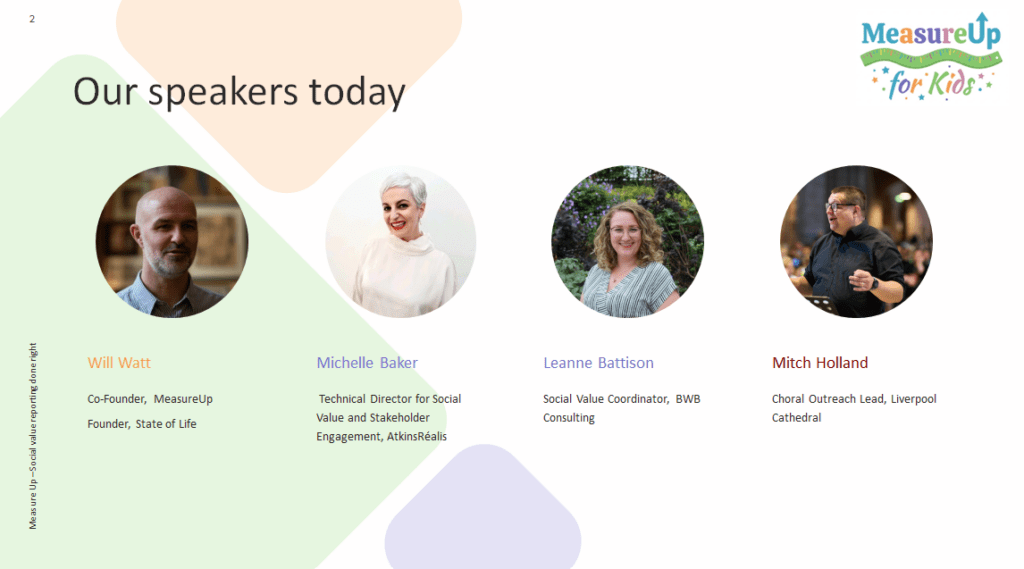
Catherine Manning (Impact Reporting / MeasureUp) opened the session and guided the group through the toolkit walkthrough. Catherine has been at the centre of building MeasureUp as a genuinely open, democratised resource: one that’s free to use, transparent in its methodology, and designed to work for organisations of all shapes and sizes.
Will Watt (Co-Founder, MeasureUp / Founder, State of Life) brought the wellbeing economics behind the toolkit, specifically the new C-WELLBY, or Children’s Wellbeing Year, and how it was developed in collaboration with LSE.
Michelle Baker (Technical Director for Social Value and Stakeholder Engagement, AtkinsRéalis) explained why AtkinsRéalis chose to sponsor this work and what drew her to MeasureUp in the first place.
Leanne Battison (Social Value Coordinator, BWB Consulting) shared BWB’s educational engagement programme as a real-world case study for applying the toolkit, including some refreshingly honest reflections on what’s been frustrating about measurement up to now.
Mitch Holland (Choral Outreach Lead, Liverpool Cathedral) brought the lived experience of a VCSE organisation working directly with children, and what it looks like when you try to put a value on something like a singing programme.
Why children? Why now?
Catherine set the tone for the session clearly: children are part of our communities whether or not we work with them directly, whether or not we have children in our families. Social value practitioners have a responsibility to include them – and that means having tools that actually work.
The policy context is moving fast. Will Watt flagged the Children’s Wellbeing Act currently going through parliament, and the work of economists like Gus O’Donnell (former head of the Civil Service) who has been actively pushing for better measurement in this space. The HM Treasury supplementary guidance now includes wellbeing economics. The tools are there for adults. The gap, until recently, has been children.
The C-WELLBY: a new measure of children’s wellbeing
Will Watt has been working in social value measurement for a decade – doing what he cheerfully describes as the grunt work: measuring wellbeing with real people, in real time, on the ground. It was through this practical work, alongside LSE economists Alan Little (formerly at the Department for Education) and others, that the C-WELLBY was developed.
The core challenge is a technical one. The standard adult measure of wellbeing asks: “Overall, how satisfied are you with your life nowadays?” Life satisfaction is a concept that doesn’t translate straightforwardly to children – particularly younger ones. So the research team at LSE mapped children’s measures (happiness, and the well-established Strengths and Difficulties Questionnaire used in schools) onto the life satisfaction scale, validating them so they produce an equivalent, credible economic value.
The result is a monetised wellbeing value of £15,920 per child per year (in 2024 prices) — what MeasureUp calls the C-WELLBY, or PW2: Improved Children’s Wellbeing. This gives organisations a way to translate improvement in children’s wellbeing into the same kind of economic language that commissioners and funders understand.
Will was clear about the point of this: it’s not about reducing children to a number. It’s about making sure that children’s wellbeing can be included in the decision-making that shapes their lives – and that organisations doing good work can demonstrate its value rather than watching it get dismissed because it can’t be measured.
“I was left feeling quite frustrated”
Leanne Battison’s section was one of the most useful parts of the session – partly because of what BWB has built, and partly because of how honestly she described the problem that brought her to MeasureUp.
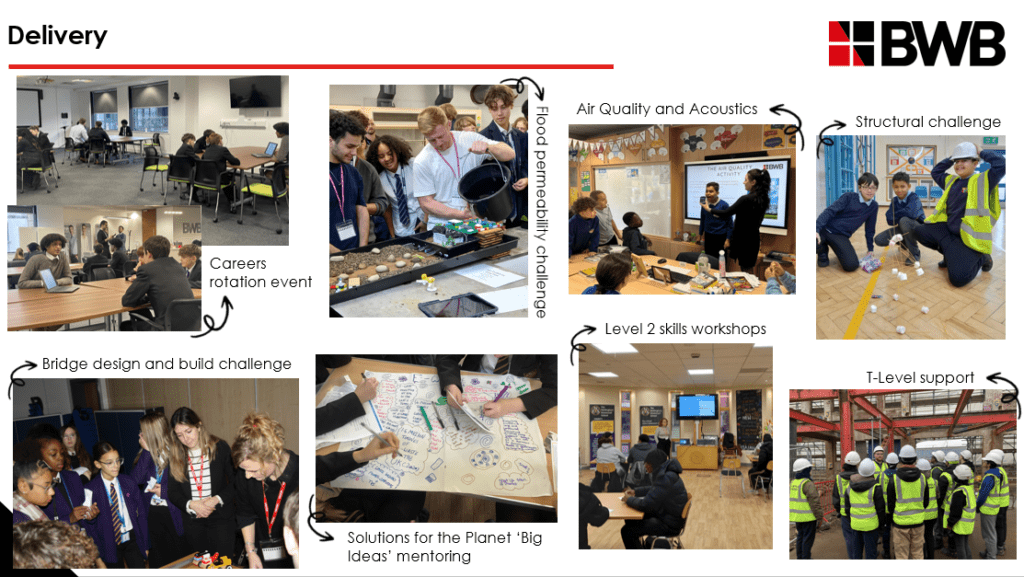
BWB is an engineering and environmental consultancy with five UK offices. Educational engagement has been a core part of their social value strategy: careers talks, mock interviews, practical STEM sessions, mentoring, T-Level support, species identification (yes, including matching animals to their droppings – apparently a big hit), and a multi-year engagement journey structured around the Gatsby Benchmarks.
The programmes are genuinely thoughtful. They’re long-term. They’re co-designed with schools. They measure feedback from students, teachers, and colleagues. They apply deadweight: when 70% of students said a programme would inform their future, BWB didn’t claim 100% – they discounted for the 30% who might have got there anyway.
And yet, when Leanne went looking for a measurement approach that could do justice to this work, she found one that valued a senior engineer’s hour-long careers talk to 30 students at around £17. Not per student. In total.
That’s not a measurement. That’s a rounding error.
MeasureUp’s WWD4 Engaging in Youth Activities value (which had been designed for adult volunteering) became the starting point for a collaborative process to develop something better: a measure that accounts for the number of students reached, the duration of the activity, whether the school serves a deprived area, and whether the activity is directly employability-related. It’s the kind of measurement that reflects what the work is actually trying to achieve.
Leanne also raised something worth sitting with: because the current measurement landscape doesn’t value this work properly, BWB sometimes finds it difficult to include educational engagement in tender proposals at all. The effort goes unrecognised. That’s a systemic problem the toolkit is directly designed to address.
Liverpool Cathedral’s Schools Singing Programme
Mitch Holland joined from Liverpool Cathedral to represent a very different kind of organisation – an anchor VCSE institution running a Schools Singing Programme (SSP) with primary school children across Merseyside.
The SSP isn’t a peripheral activity. It’s a structured programme of vocal training, musical literacy, and collaborative performance, with a clear theory of change linking participation to confidence, wellbeing, and learning outcomes. What it hadn’t had, until working with MeasureUp, was a way to translate that into social value language.
The toolkit includes an impact pathway for the SSP, tracing the logic from child attends singing group through to outputs (type of session, number of pupils, demographics), outcomes (learning outcomes, building confidence, fostering happiness and wellbeing), and monetised impact. The case study also demonstrates how to work through the MeasureUp values table (WWD4, PW2, and ES3) and assess which values are genuinely appropriate for which programmes, rather than claiming everything and over-valuing the impact.
For the ES3 Bronze level valuation example shown in the session, 1,000 students attending 10 weeks of half-hour choral workshops came out at a discounted social value of approximately £350,000 – after applying a 50% discount to reflect that the programme isn’t directly designed as a wellbeing intervention, even if wellbeing improvements are a real outcome.
What’s in the toolkit?
The MeasureUp for Kids toolkit is built around a four-step process:
Step 1: Define who and what — identify your stakeholders, describe your activities, define your outcomes (intended and unintended, positive and negative).
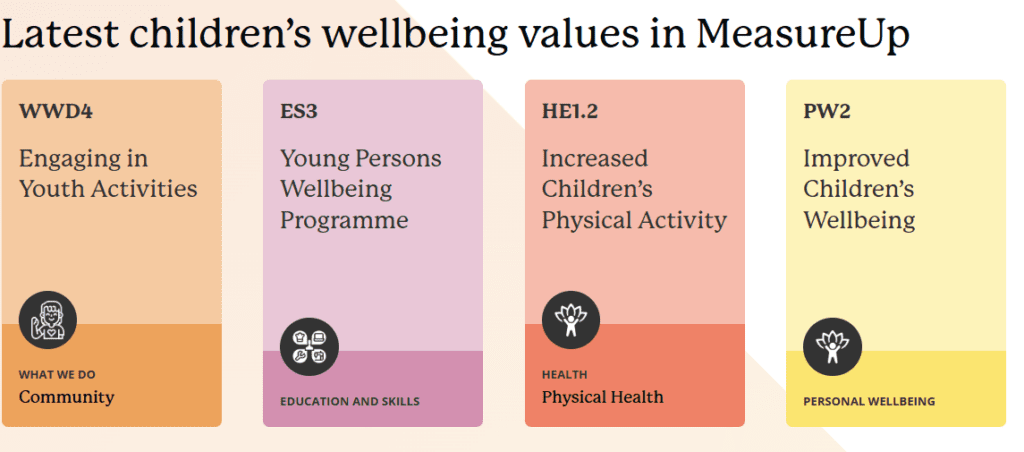
Step 2: Match with MeasureUp values — use the children’s stakeholder filter to find the values that fit your work. The three most relevant for children’s programmes are:
- WWD4 Engaging in Youth Activities
- ES3 Young Persons Wellbeing Programme
- He1.2 Increased Children’s Physical Activity
- PW2 Improved Children’s Wellbeing (using the C-WELLBY)
Step 3: Record the details — quantity (how many people, how many units), duration (how long the outcome lasts), and the correct unit of measurement aligned to each value.
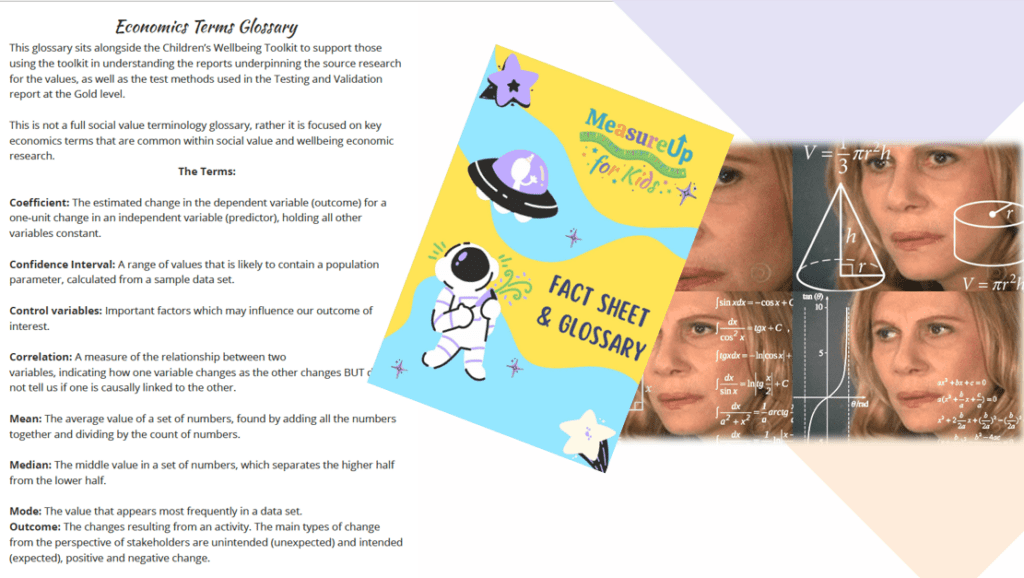
Step 4: Calculate the monetised value — at Bronze (proxies and estimation), Silver (demographic adjustments), Gold (survey data and direct measurement), or Gold+ (with appropriate impact discount). The toolkit includes worked examples, an action checklist, an impact pathway template, and an economics terms glossary for those who want to understand the research underpinning the values.
Sponsorship and collaboration
Michelle Baker’s involvement (and AtkinsRéalis’s decision to sponsor the toolkit)came out of a genuine belief in what Professor Chris White, the architect of the Social Value Act, has said for years: that for social value to really have impact, private, public, and third sector organisations all need to work together. Michelle had been watching MeasureUp for years before her Global Fellowship for Social Impact gave her the vehicle to make the partnership happen. The result is a free resource that any organisation can access – including those without the budget for monitoring and reporting software.

What’s coming next?
The MeasureUp roadmap includes updates to the Ideal Value Set, new economic input values (supply chain spend, donations, real living wage, resources invested), updated methodology and guidance, and an estimator tool – all in alignment with the new Social Value Model.
If you’d like to get involved – to use the toolkit, sponsor a value, or help spread the word – get in touch at hello@measure-up.org or visit measure-up.org.
For extra help with your social value practice, reach out to PRD for strategic planning, Impact Reporting for data management and social value software, or State of Life for valuation research and stakeholder engagement.
Explore the toolkit
👉 https://measure-up.org/how-to-use/measureup-for-kids/